
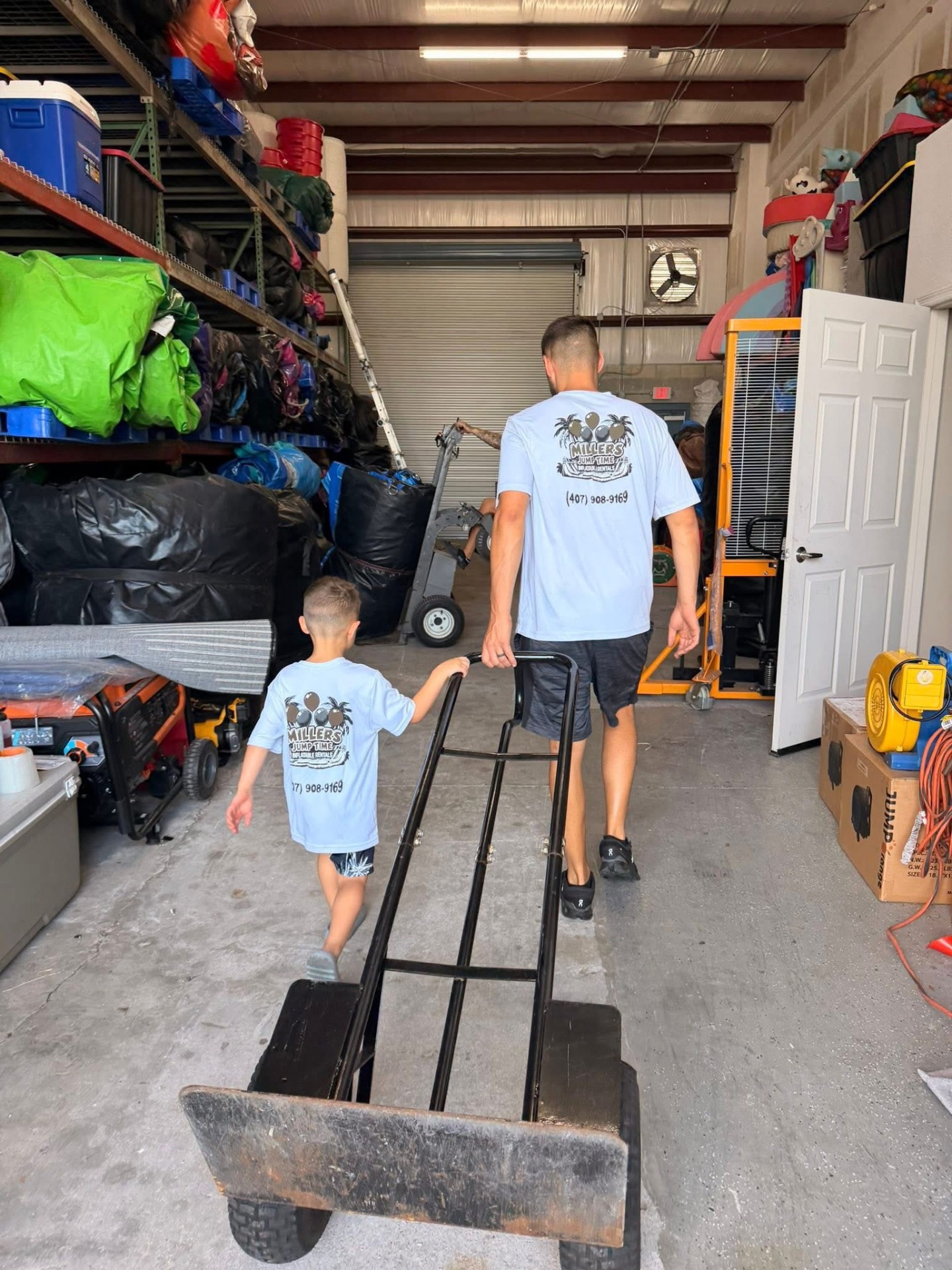
Five years ago, an electric dolly was a luxury, something the biggest operators bought to flex on Facebook. Today it is closer to standard kit for any company moving combo units, large slides, or 30-foot obstacle courses. The reason is simple: a single operator with the right motorized dolly can load, deliver, set up, tear down, and return a heavy commercial inflatable that previously needed two people. That changes the entire labor model of a party rental business.
Independent guide. We have no affiliate relationships, sponsorships, or paid placements with any dolly manufacturer mentioned in this article. Prices and specs were sourced directly from each manufacturer's public website at the time of writing, verify the current price before buying.
Why operators switched to electric dollies
A wet 25-foot combo with a slide can weigh 600 to 900 lbs once it is rolled. A larger commercial water slide easily exceeds 1,000 lbs. Pushing that load up a residential driveway, across wet grass, or up a trailer ramp by hand is the single most common cause of two things: blown backs and second hires. Electric dollies eliminate both.
- One-person setups become realistic for units that used to require two crew members.
- Loading and unloading the trailer goes from a 10-minute team effort to a 2 to 3 minute solo job, many models include a powered winch that pulls the unit up the ramp for you.
- Soft ground, gravel, mud, and curbs stop being deal-breakers. Most motorized dollies use 18-inch pneumatic drive tires that walk over terrain that locks up a manual hand truck.
- Injury risk drops dramatically. Lower-back injuries are the #1 workers' comp claim in this industry, and they almost always trace back to lifting and pushing wet inflatables.
- You can take more bookings per day with the same crew because turnaround time per stop drops 15 to 30 minutes.
What electric dollies actually cost
Pricing is wide because the category covers everything from a simple 2-wheel powered hand truck to a 4-wheel, 1,500-lb-capacity, winch-equipped platform. Here is the current landscape based on publicly listed prices from the major manufacturers.
| Type | Typical Price | What you get |
|---|---|---|
| Heavy-duty manual 2-wheel dolly | $1,000 to $1,500 | No motor. Wider base, footbrake, larger wheels than a Home Depot hand truck. The Jolly Dolly HD lists at $1,095. |
| Manual 4-wheel quad dolly | $1,400 to $1,700 | Four-wheel platform with collapsible swivel casters. Better for very heavy units on flat ground. Jolly Dolly HD Quad lists at $1,495. |
| Manual dolly with built-in winch | $1,800 to $2,300 | Hand-cranked or 12V winch system that pulls the inflatable onto the dolly and up trailer ramps. Jolly Dolly HD Winch lists at $1,895. |
| Motorized 2-wheel electric dolly | $2,500 to $3,500 | Smaller battery-powered units suited to medium combos. One Trip Dolly E-Plus lists at $3,999 with the angled inflatable wing. |
| Premium 4-wheel motorized dolly | $4,500 to $6,500 | 1,000, 1,500 lb capacity, 48V lithium drivetrain, electromagnetic brake, terrain tires. The 48V Diamondback (via BounceWave) starts at $4,995. |
| Motorized dolly + integrated winch | $5,500 to $7,500 | Adds an onboard powered winch for one-person trailer loading. The Diamondback with Winch is the upgraded SKU above the standard $4,995 model. |
Freight is not included on most of these dollies. Budget another $150 to $400 in shipping depending on your distance from the manufacturer, this catches a lot of new operators off guard at checkout.
Warranties, what is actually covered
Warranty terms vary widely and are usually shorter than people assume. Here is what the major manufacturers publish on their product pages today.
- BounceWave Diamondback (motorized): 1-year limited warranty covering parts and support. Battery and motor are included in the parts coverage; consumables (tires, brake pads, throttle grip) are not.
- The Jolly Dolly: Frame is warrantied against manufacturing defects; motor and electrical components on the Power PRO carry a separate, shorter warranty, confirm in writing before you buy.
- Moonwalk USA Electric Dolly: Sold under Moonwalk's standard 1-year workmanship warranty for new equipment.
- One Trip Dolly E-Plus: Manufacturer warranty on the drivetrain; battery is typically covered for a shorter window than the frame.
- Custom builders like Good Time Fabrication (GTF) often offer direct lifetime warranty on the welded steel frame but pass through the component warranty on motors and batteries.
Battery is the part most likely to fail first and the part most likely to be excluded from a long warranty. Always ask the manufacturer to put the battery warranty in writing, not just the dolly warranty.
Common breakdowns and what they cost to fix
Electric dollies are mechanical equipment that lives outside, gets wet, and carries 1,000+ lbs across rough terrain every weekend. They break. Knowing what fails, and what the repair actually costs, is the difference between a frustrating Saturday and a destroyed weekend.
- Battery degradation (most common). Lithium 48V packs lose noticeable range after 2 to 4 years of weekly heavy use. Replacement packs run $400 to $900 depending on the manufacturer. Cheaper sealed lead-acid packs are about half that but weigh much more.
- Throttle assembly failure. The thumb throttle gets exposed to rain and dust. Replacement parts are usually $40 to $120 and self-installable.
- Brake controller / electromagnetic brake failure. Symptoms: the dolly rolls when you let off the throttle on an incline. Repair is $150 to $400 if you replace the controller yourself, more if you ship it back.
- Drive transaxle / motor wear. The most expensive failure. A direct-drive 48V transaxle is typically $700 to $1,500 to replace, plus labor if you cannot do it yourself. Avoiding overload is the best prevention, most published 1,500 lb capacities are not meant to be used at 100% every single day.
- Tire punctures and flat-spotted casters. Cheap and frequent. Keep two spare pneumatic casters and a tube patch kit on the truck.
- Frame weld cracks. Rare on premium models, more common on budget Asian-import dollies. A cracked weld near the deck is repairable by any local welder for $75 to $200.
How efficient are they really?
Real-world numbers from operators using motorized dollies for the better part of a season look roughly like this, yours will vary based on the units you carry and how rough your delivery sites are.
| Task | Manual hand truck (2 people) | Motorized dolly (1 person) |
|---|---|---|
| Unload combo from trailer | 5 to 8 minutes | 1 to 2 minutes (with winch) |
| Roll combo across yard to setup spot | 4 to 6 minutes | 2 to 3 minutes |
| Load wet/heavy combo back onto trailer | 8 to 15 minutes | 2 to 4 minutes |
| Total per stop (round trip) | 20 to 30 minutes labor | 5 to 10 minutes solo |
The labor savings, why it pays for itself
Here is a conservative ROI calculation for a small operator who runs 6 combo deliveries per Saturday during the season. Assume your second helper costs you $20/hour fully loaded (wage plus payroll tax plus a bit of fuel for the second vehicle).
- Time saved per stop with a motorized dolly: ~20 minutes of one person's labor.
- 6 stops × 20 minutes = 2 hours of saved second-person labor per Saturday.
- 2 hours × $20/hour = $40 saved per Saturday in direct labor.
- 30 active Saturdays per season × $40 = $1,200/year in direct labor savings.
- Add Sundays and weekday school events and most operators recover $1,800 to $3,000/year in second-helper hours alone.
- Premium $4,995 dolly payback period: roughly 18 months to 2.5 seasons. After that, the dolly is paying you back every weekend it goes out.
The math above only counts direct labor. It does not count the bookings you can take because you no longer need to coordinate a second person, the back injury you did not have, or the customer reviews you earned by setting up faster and looking more professional.
Powered winch vs. hand winch, is the upgrade worth it?
A winch, powered or manual, is what lets one person load a heavy inflatable up a trailer ramp without lifting it. The question is just whether you crank it by hand or push a button.
Pros
- Powered winch turns trailer loading into a 60-second push-button job.
- No upper-body fatigue at the end of a 10-stop Saturday.
- Faster turnaround = more bookings per crew per day.
- Crews who had to quit because of back/shoulder pain can keep working.
Cons
- Adds roughly $500 to $1,500 to the dolly price.
- One more electrical component that can fail (winch motors are usually the second-most-common breakdown after the battery).
- Heavier dolly overall, adds to total trailer tongue weight.
- Manual hand-crank winches are cheap, simple, and almost never fail.
Buying guide, match the dolly to your operation
- Just doing 13×13 bouncers and small combos: A heavy-duty manual dolly ($1,000 to $1,500) is plenty. Skip the motor for now.
- Mix of combos and 1, 2 large slides: A motorized 2-wheel dolly in the $2,500 to $3,500 range is the sweet spot.
- Daily commercial water slides, obstacle courses, or 30+ foot units: Go straight to a 4-wheel premium motorized dolly with winch. The price hurts once; the back injury hurts forever.
- Solo operator (no second crew member): A motorized dolly with winch is not optional, it is the entire reason your business model works.
- Rough delivery sites (rural, gravel driveways, hills): Prioritize 18-inch pneumatic drive tires and an electromagnetic brake over a fancy paint job.
Bottom line
An electric dolly is the single most impactful piece of equipment most growing party rental operators add after their first trailer and their first commercial blower. It is not glamorous, it does not show up in marketing photos, and customers never see it. But it changes how many bookings one person can run, how long your back lasts, and how cheaply you can scale before you have to hire your second full-time helper. For most operators doing 5+ stops a Saturday, the question is not whether to buy one, it is which one and when.