
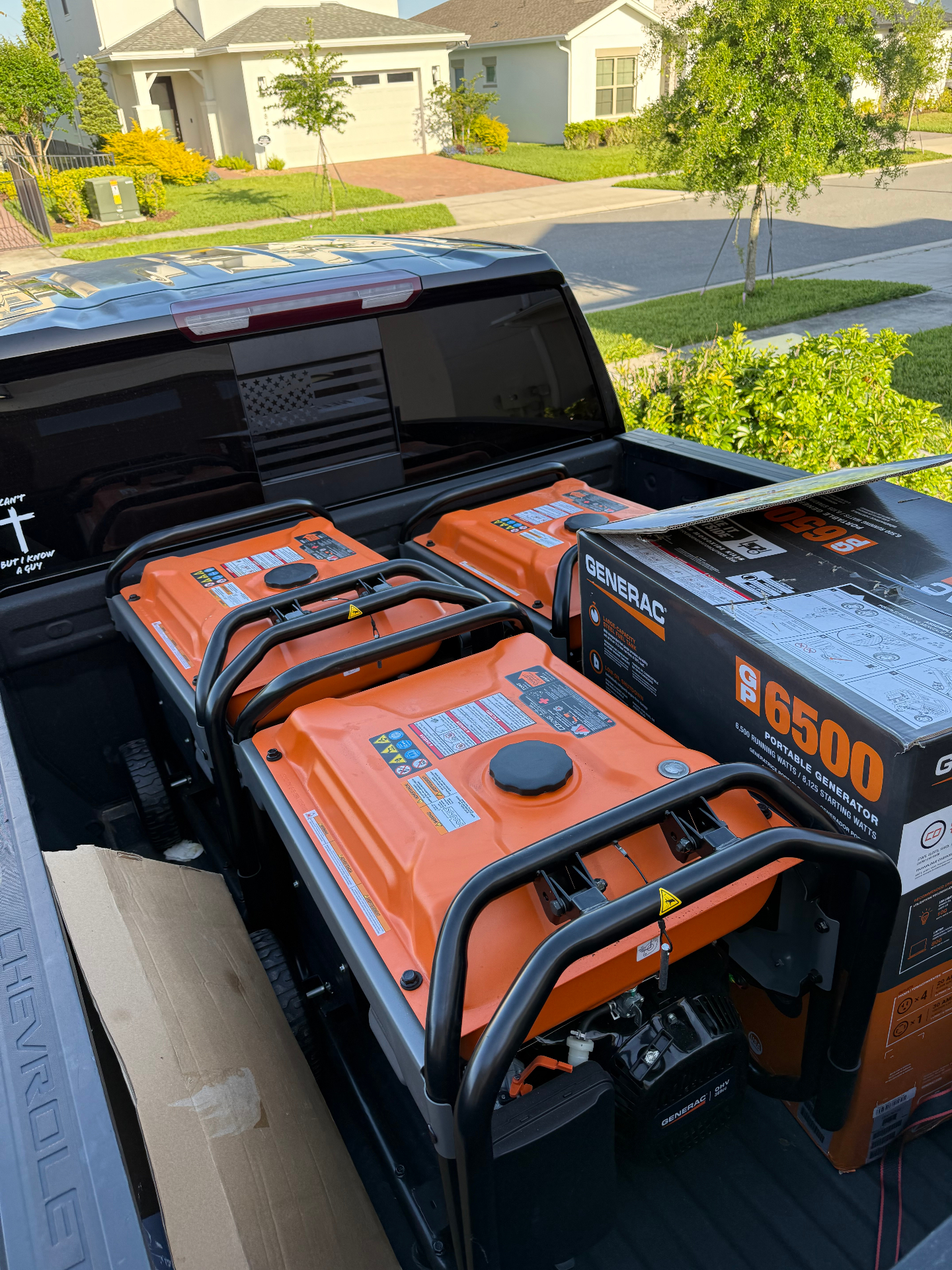
I learned this the hard way at a church carnival in my second year. I showed up with a $300 Harbor Freight generator, plugged in a single blower, and the thing was screaming so loud you could not hear the praise band 50 feet away. The pastor pulled me aside and asked if I could 'turn it down.' You cannot turn down a contractor generator. I went home, sold it on Marketplace, and bought a real inverter generator the next week. Three years later it has paid for itself fifty times over.
Wattage you actually need
A standard inflatable blower draws about 1 to 1.5 horsepower, which translates to 750 to 1,100 running watts and 1,500 to 2,200 starting watts (the surge when the motor kicks on). Always size your generator off starting watts, not running watts. Underestimate and your generator will trip every time you fire up another blower.
| Number of blowers | Starting watts needed | Running watts needed | Recommended generator size |
|---|---|---|---|
| 1 blower | 1,800 to 2,200 | 750 to 1,100 | 2,000 to 2,500 watt inverter |
| 2 blowers | 2,800 to 3,500 | 1,500 to 2,200 | 3,500 to 4,000 watt inverter |
| 3 blowers | 4,000 to 5,500 | 2,250 to 3,300 | 5,000 to 6,500 watt inverter |
| 4+ blowers | 5,500+ | 3,000+ | 7,500 to 10,000 watt unit (run two smaller in parallel) |
When running multiple blowers, do not start them all at the same time. Start one, let it stabilize, then start the next. This prevents the surge load from tripping your generator's overload protection.
Inverter vs conventional generator
If you are buying for the rental business, get an inverter generator. Period. The price difference is real (an inverter costs about double a conventional unit of the same wattage) but the benefits are huge:
- Quieter operation, 53 to 60 decibels at 25 feet vs 75 to 85 decibels for a conventional unit. The difference between background noise and 'sir, can you move that thing.'
- Cleaner power (true sine wave) that will not damage blower motors over time.
- Better fuel economy, often half the gas use of a comparable conventional generator.
- Lighter, smaller, easier to load and unload solo.
- Eco mode automatically throttles down when load is light, extends runtime dramatically.
Specific models operators actually run
| Model | Watts (starting/running) | Price | Best for |
|---|---|---|---|
| Honda EU2200i | 2,200 / 1,800 | $1,100 to $1,300 | Single bounce house. Gold standard for reliability and quiet operation. |
| Yamaha EF2200iS | 2,200 / 1,800 | $1,000 to $1,200 | Honda alternative, slightly quieter, slightly cheaper. |
| Westinghouse iGen2200 | 2,200 / 1,800 | $550 to $700 | Budget pick that actually works. Not as long lasting as Honda but reliable for 2 to 3 seasons. |
| Champion 4500W Inverter | 4,500 / 3,500 | $1,000 to $1,300 | Two to three blowers. Wireless remote start is a nice luxury. |
| Honda EU3000iS | 3,000 / 2,800 | $2,200 to $2,500 | Two blowers all day. The pro choice for operators running multiple parties. |
| DuroMax XP4400iH | 4,400 / 3,500 | $700 to $900 | Dual fuel (gas and propane), good for operators who hate dealing with stale gas. |
| Predator 3500 Inverter | 3,500 / 3,000 | $800 to $950 | Harbor Freight. Surprisingly good for the price, runs 2 blowers comfortably. |
If you can only afford one generator, get the Honda EU2200i. It will outlast every cheaper unit you buy, holds resale value better than any generator on the market, and will not embarrass you at a church or school event.
Fuel cost per event
Most inverter generators in eco mode burn about 0.15 to 0.25 gallons per hour with a single blower load. A typical 4 hour event uses 0.6 to 1 gallon of gasoline. At $3.50 a gallon, fuel cost per event is $2 to $4. Budget $5 a job for fuel and oil and you will not be surprised.
Noise rules and what to actually expect
Most cities have a 65 decibel daytime limit at the property line. Inverter generators measured at 25 feet usually run 53 to 60 decibels in eco mode. That puts you under the limit at any reasonable distance. Conventional generators (75 to 85 decibels) violate noise ordinances at most residential properties. The neighbors will call. Just buy an inverter.
Setup tips that save your unit
- Place the generator at least 25 feet from the inflatable, downwind. Prevents exhaust fumes from blowing into the unit.
- Use a 12 gauge minimum extension cord. 14 gauge cords cause voltage drop that wears out blower motors.
- Plug each blower into its own outlet on the generator. Daisy chaining causes overload trips.
- Place the generator on a flat surface, away from foot traffic. Vibration is normal but tipping is not.
- Keep a small bag of generator essentials in your truck: 2 quarts of oil, funnel, spark plug wrench, spare extension cord, ear plugs.
- Refuel only when the generator is off and cool. Do not be that operator on the news.
Maintenance that doubles generator life
- Change the oil every 25 hours of use, or once at the start and once at the end of every season.
- Drain the carburetor (or run it dry) before storing for the off season. Stale gas is the number one cause of generator failure.
- Use stabilizer in your gas year round if you do not refuel weekly.
- Clean the air filter every 3 to 4 months during heavy use.
- Replace the spark plug annually. Costs $4 and saves a service call.
- Test fire the generator every month, even off season. Letting it sit for 6 months kills carburetors.
Bottom line
Get a 2,200 watt inverter generator (Honda EU2200i if you can afford it, Westinghouse iGen2200 if you cannot) before you book your first park event. Maintain it like a real piece of business equipment. It will pay for itself the first weekend you book a 'no power on site' gig that other operators cannot take.