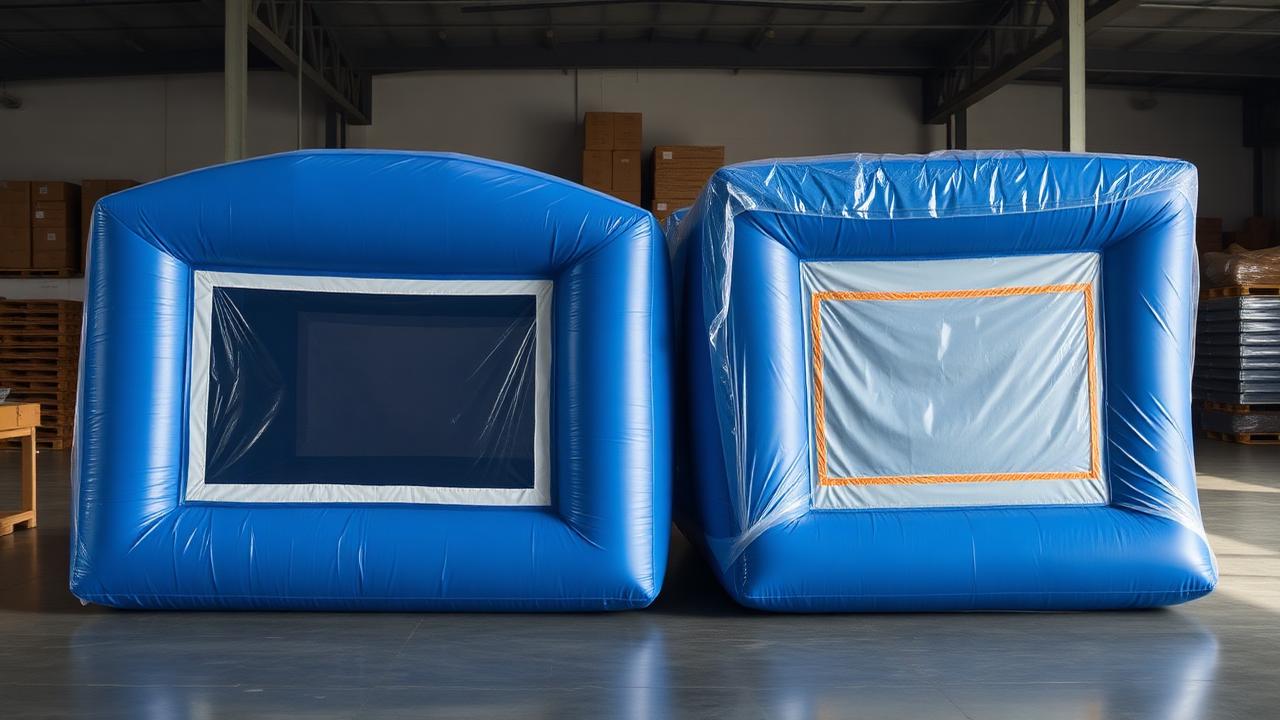
When my second daughter was born I was about a year into the business and I needed a second bounce house badly. I had two paths: $1,800 for a brand new commercial castle, or $900 for a used one off Facebook Marketplace. I bought the used one. It paid for itself in three weekends and lasted four full seasons before I sold it for $400. That is the dream scenario. Plenty of operators chase that dream and end up with a moldy, leaking pile of vinyl. Here is how to tell the difference.
What you actually pay (real 2026 prices)
| Unit type | New (commercial) | Used (good condition) | Used (rough condition) |
|---|---|---|---|
| Castle bounce house (13x13) | $1,400 to $2,000 | $700 to $1,100 | $300 to $600 |
| Combo unit (bounce + slide) | $2,400 to $3,800 | $1,400 to $2,000 | $600 to $1,200 |
| Water slide (15 ft) | $2,800 to $4,500 | $1,500 to $2,400 | $700 to $1,400 |
| Obstacle course (30 ft) | $5,500 to $9,000 | $3,000 to $5,000 | $1,500 to $2,800 |
| Dual lane water slide (20 ft) | $5,000 to $8,500 | $2,800 to $4,500 | $1,200 to $2,400 |
The depreciation curve nobody talks about
Commercial inflatables lose value fast in the first year and then plateau. A $1,800 castle is worth about $1,200 after the first season, $900 after the second, and $500 to $700 by year four if it has been well maintained. After that, the value is mostly the blower and the carry bag. Knowing this curve is everything when you decide what to pay for used.
- Year 1 to 2: about 35 to 45 percent depreciation. Avoid buying anything 'lightly used' for more than 60 percent of new price.
- Year 3 to 4: another 20 to 25 percent. This is the sweet spot for buying used, you get a unit with proven durability at half the new price.
- Year 5+: another 15 to 20 percent. Risky territory. Vinyl gets brittle, seam stitching weakens, blower bearings start failing.
- Year 7+: scrap value or donor parts only. The unit may still inflate but it will not survive a hard rental season.
The number one rule of buying used: never pay more than 50 percent of the new price for a unit you have not personally inspected.
Where to safely buy used inflatables
- Other operators (best source). Most are honest about condition and willing to deliver. Find them in regional Facebook groups (Inflatable Operators Network, Bounce House Owners Association).
- Manufacturer rental fleets. Some manufacturers (eInflatables, Cutting Edge) periodically sell off their demo or short term rental fleet at major discounts. Watch their social media.
- Trade show floor models. After IAAPA and the major regional shows, manufacturers often discount the units they hauled in for display. 25 to 40 percent off new pricing with full warranty.
- Bankruptcy and going out of business sales. When an operator quits, their fleet usually sells fast at 30 to 50 percent of fair market value.
- Auction sites (BidSpotter, Proxibid). Higher risk because you cannot inspect, but the prices can be incredible for operators willing to gamble.
What to inspect before you hand over money
- Inflate it fully and walk every seam. Any gap, fraying thread, or visible vinyl separation is a red flag.
- Check the netting. Holes larger than a quarter mean you will be patching constantly.
- Look for mold or mildew stains, especially in the corners and along the floor. Mold means it was put away wet repeatedly. Hard pass.
- Inspect the blower tube for tears or duct tape repairs. Blower tubes are stress points, sloppy repairs fail fast.
- Test the blower. Should kick on smoothly, run quietly, and inflate the unit in under 90 seconds for a standard castle.
- Check the floor for sun damage (chalky, faded vinyl). Sun damage is irreversible.
- Smell test. A used unit should smell like vinyl, not gym socks. Lingering odor means soaked vinyl that never fully dried.
- Ask for the original owner's manual and any inspection records. Operators who kept the paperwork usually maintained the unit.
True cost of ownership comparison
The sticker price is only part of the math. Used units usually need about $150 to $400 in repairs and patches in the first season. New units come with a 1 to 3 year warranty that covers seam separation and blower failures. Here is the realistic 4 year cost comparison for a standard 13x13 castle:
| Cost over 4 years | New unit | Good used unit |
|---|---|---|
| Purchase price | $1,800 | $900 |
| Repairs and patches | $50 (warranty covers most) | $300 |
| Replacement blower (year 3) | $0 | $180 |
| Resale value at year 4 | $700 | $300 |
| Net 4 year cost | $1,150 | $1,080 |
| Bookings to break even (at $250 each) | 5 | 5 |
The 4 year cost ends up roughly the same. The difference is how much capital you tie up upfront. Used wins if you are bootstrapping and need to spread cash. New wins if you can afford it and want fewer headaches in your first season.
When to buy new (no exceptions)
- Wet inflatables and water slides. Used water gear hides damage you cannot see and the consequences of a failure are way worse than dry units.
- Anything with a slide over 12 feet tall. Stitching stress at height is brutal, you do not want a 6 year old unit.
- Obstacle courses. They take twice the abuse of bounce houses, used ones rarely have life left.
- Your first ever unit. Learn what 'good condition' actually feels like before you start grading used vinyl.
When to buy used (smart move)
- Standard dry castle bounce houses. The most forgiving category, easy to inspect, plenty of supply.
- Backup units for high demand weekends. A used unit you only run when you are sold out is a money printer.
- Niche themes (princess, superhero, sports). New ones run $2,000+. Used ones at $700 give you variety without the cash hit.
- Anything you plan to resell after one season. Buy at 40 percent of new, run it 20 weekends, resell at 30 percent of new. Net cost per booking is tiny.
Bottom line
If you have the cash and you want a clean three year run with a warranty, buy new from a US manufacturer (we list every reputable one in our independent manufacturer directory). If you are bootstrapping or you need to grow your fleet fast, buy used from other operators with a thorough inspection. Either way, do the math before you hand over money. The biggest mistake operators make is paying too much for either.