
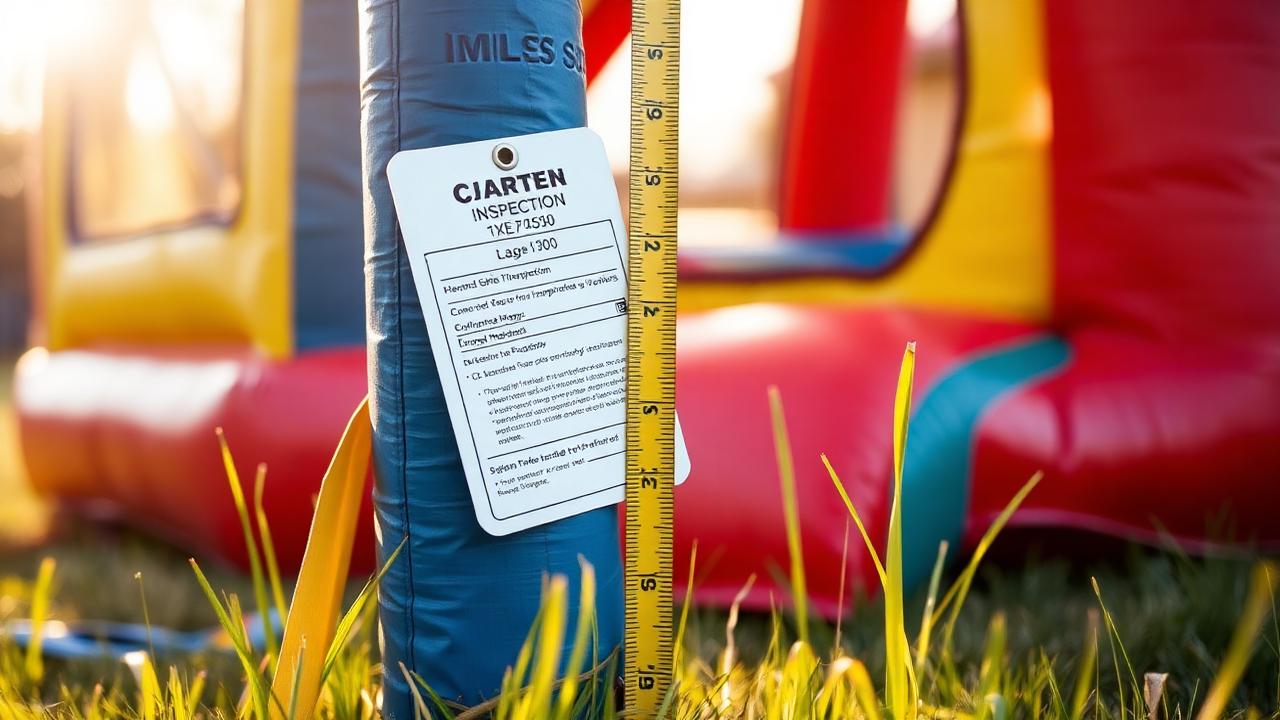
When a customer asks 'is this thing safe?' the right answer is not 'yes' with a smile. The right answer is 'yes, we set it up to ASTM F2374 standards, here is how.' Operators who can speak the language of the safety standard close more school and church bookings, win more inspector arguments, and pay less for insurance.
This is a plain English summary of ASTM F2374 for educational purposes. The full standard is the controlling document. Buy a copy from astm.org if you want the legal version.
What ASTM F2374 actually is
ASTM F2374 is the international consensus standard titled 'Standard Practice for Design, Manufacture, Operation, and Maintenance of Inflatable Amusement Devices.' It is written by the ASTM F24 Committee on Amusement Rides and Devices, the same committee that writes the standards for roller coasters and zip lines. Most state inspectors and most insurance carriers reference F2374 by name in their policies and rulebooks. If your operation does not follow it, you are operating outside the recognized standard of care.
Setup requirements you must follow
- Anchor every inflatable to the manufacturer specification. Most units require 4 to 8 anchor points. Stakes for grass, sandbags or water weights for hard surfaces.
- Stake length: minimum 18 inches in soft soil, 30 inches if the soil is loose or sandy. Driven at a 45 degree angle away from the unit.
- Sandbags: minimum 40 pounds per anchor point on hard surfaces. Most operators use 50 to 75 pound bags for safety margin.
- Maintain a 6 foot safety zone around every inflatable, free of obstacles, fences, walls, and overhead obstructions.
- Keep at least 25 feet of clearance from any electrical line, septic system, or in ground irrigation head.
- Inflatables on slopes greater than 5 degrees require special anchoring or relocation. Steep slopes are a flat no.
Weather rules in the standard
F2374 sets the operational weather limits that almost every manufacturer adopts in their owner's manual. Memorize these numbers, they are the difference between a safe event and a denied insurance claim.
| Condition | ASTM threshold | Operator action |
|---|---|---|
| Sustained wind | Above 25 mph | Take the unit down. Most manufacturers spec lower, follow the lower number. |
| Wind gusts | Above 25 mph forecast | Do not set up. If already up, evacuate riders and deflate. |
| Lightning | Within 10 miles | Clear all riders, deflate or relocate, wait 30 minutes after last strike. |
| Heavy rain | Visibility limited or surface slippery | Suspend operation. Wet inflatables are slip hazards. |
| Freezing temps | Below 32 F | Do not operate. Vinyl gets brittle and can crack. |
Pull a real wind reading at the site, do not guess. A $20 handheld anemometer (Kestrel, BTMETER, AcuRite) lets you document actual wind speed in your setup log. That documentation has saved operators in claims more than once.
Operator responsibilities while running the unit
- A trained attendant must be present and watching the inflatable at all times during operation. Not 'kind of watching from the patio while drinking a beer.' Watching.
- The attendant must enforce rider rules: no shoes, no food or drink, no glasses or sharp objects, no flips, no climbing on the walls.
- Maximum rider count posted on the unit must be enforced. F2374 expects the attendant to count and rotate.
- Riders should be grouped by similar size and age. A 12 year old and a 4 year old together is a fast trip to a broken arm.
- If the blower kicks off or the unit starts to deflate, evacuate immediately, no exceptions.
- Daily pre rental inspection: stitching, seams, anchor points, blower function, no exposed metal.
What to document for every event
If something goes wrong, your documentation is your defense. The operators who survive lawsuits and insurance disputes are the ones who took 90 seconds to fill out a setup log on every job.
- Date, time, and address of the setup.
- Wind reading at setup (use your anemometer).
- Photo of the unit fully inflated showing all anchor points engaged.
- Photo of the safety zone around the unit.
- Signed waiver from the customer (and from any party host who is not the booking customer).
- Signed acknowledgement that the customer received and read the operator instructions.
- Time of teardown and any incidents during the rental.
What inspectors look for
In the 14 states that actually inspect inflatables (Pennsylvania, New Jersey, Florida, California, and others), an inspector can show up at any commercial event. They check three things first: anchoring, current insurance certificate, and a trained attendant on site. Fail any of those and they will shut you down on the spot.
- Inspection sticker or permit visible on the unit (state by state, see our [permit and inspection guide](/resources/state-permit-inspection-rules)).
- Anchors driven to manufacturer spec. They will count stakes.
- Current commercial general liability certificate, available on the spot.
- Trained attendant present, sometimes asked to recite weather thresholds.
- Current owner's manual or operating instructions accessible.
- Last inspection date documented (some states require annual third party inspections).
Where operators get it wrong
- Skipping anchors on hard surfaces because 'sandbags are heavy.' Hard surface setup without proper ballast is the number one cause of injury inflatable accidents.
- Letting the customer's teenager 'watch' the bounce house. Untrained attendants do not satisfy the standard. Your insurance company knows it.
- Setting up under a tree because the yard is too small. Branches puncture vinyl, and the unit ends up in the neighbor's yard when the wind picks up.
- Cutting corners on the safety zone. 6 feet is the minimum, not the goal. Aim for 10.
- Operating in 'mostly fine' weather. The standard is binary. If wind exceeds the threshold, the unit comes down. Period.
Bottom line
ASTM F2374 is not a suggestion. It is the recognized standard of care that your insurance policy, your venue contracts, and any lawsuit against you will be measured against. Read it once, train your crew on it, document every setup, and you will sleep better at night and save thousands on insurance over the long run.